
Finding Hampton Resident Records
Hampton keeps no single public list of every person at every address. The most useful starting point depends on the question. The Assessor connects a parcel to an owner or taxpayer. Recorded instruments identify parties to a transaction. A dated directory or census can place a household in an earlier period. Court, professional, and vital sources answer different questions and often have access limits. Treat an owner, a court party, a licensee, and a listed householder as separate roles until another record ties them together.
A good Hampton residents directory search keeps the source date beside the name. A transfer row from one year and a directory entry from another do not describe the same moment. For a current address, record the parcel number and legal description before looking for deeds. For an older person, retain the printed street, locality label, and page number. Hampton absorbed Elizabeth City County and Phoebus in 1952, so older records may use a place name that no longer appears on a map.
- Start with an address in the Assessor’s property search, or with a dated directory entry when the question is historical.
- Save the parcel ID, situs address, legal description, date, and the role shown for each named party.
- Check an independent record, such as a recorded deed, court index, obituary, or license record, for the same name and time period.
- Use the Hampton Registrar only through its authorized voter route or the statute-governed list process.
- When a public record is not online, request the existing record from the correct Hampton office with a narrow date and subject description.
Hampton Resident Records Offices
Because Hampton is an independent city, the key custodians are city and state offices rather than a county government. The Circuit Court Clerk holds recorded land instruments, probate material, marriage licensing records, and circuit files. The Assessor manages the public real-estate trail. The Registrar manages election records with separate rules for self-service status checks and voter-list access. These offices can clarify whether a result is online, at a public terminal, or available only through a focused request.
Each office has a limited role. The Assessor cannot establish every household member. The Clerk’s index might identify a party to a deed without showing a present address. The Registrar has voter records but cannot make statutory protections disappear. Asking for the correct underlying record avoids an overbroad request and makes the reply more useful.
Hampton Assessor of Real Estate
One Franklin Street, Suite 602
Hampton, VA 23669
757-727-8311
Use the office that holds the record, not a general request for a person profile. The address-focused chain is covered in more detail in the Hampton by-street directory.
Hampton Parcel Records First
For a known address, the current CivQuest route is Hampton’s strongest location anchor. The Assessor directs users to the city’s property and GIS system, while legacy Parcel Viewer help describes the sorts of tabs a parcel card may contain: general details, improvements, transfers, assessments, tax information, city resources, scanned documents, and a crime-statistics area. The current interface can change, so a parcel result should be read as a record of the property, not a promise that each old tab remains available.
Start with the street number and street name, owner name, parcel or property ID, or a map selection. Compare the returned polygon, legal description, subdivision, and photo or sketch when available. The transfer and assessment tabs give a date frame. City Resources can lead to zoning, voting, service, and neighborhood information. The map can reveal adjacent parcels, but a neighboring polygon may be a road, water, or public right-of-way.
| Parcel field | Why it matters |
|---|---|
| Street address or map selection | Finds the physical property and its mapped polygon. |
| Owner name | Supplies a taxpayer or ownership lead, not a current occupancy finding. |
| Property ID | Provides a stable key for transfer PDFs, maps, and clerk research. |
| Legal description | Helps match an old deed when a street label or number changed. |
A parcel is the mapped unit of land. The situs address is its physical location. A tax mailing address may belong to an owner somewhere else. Keeping those labels separate prevents an ownership record from being misread as a list of Hampton residents.
The Hampton Assessor links the current property route used for this search.
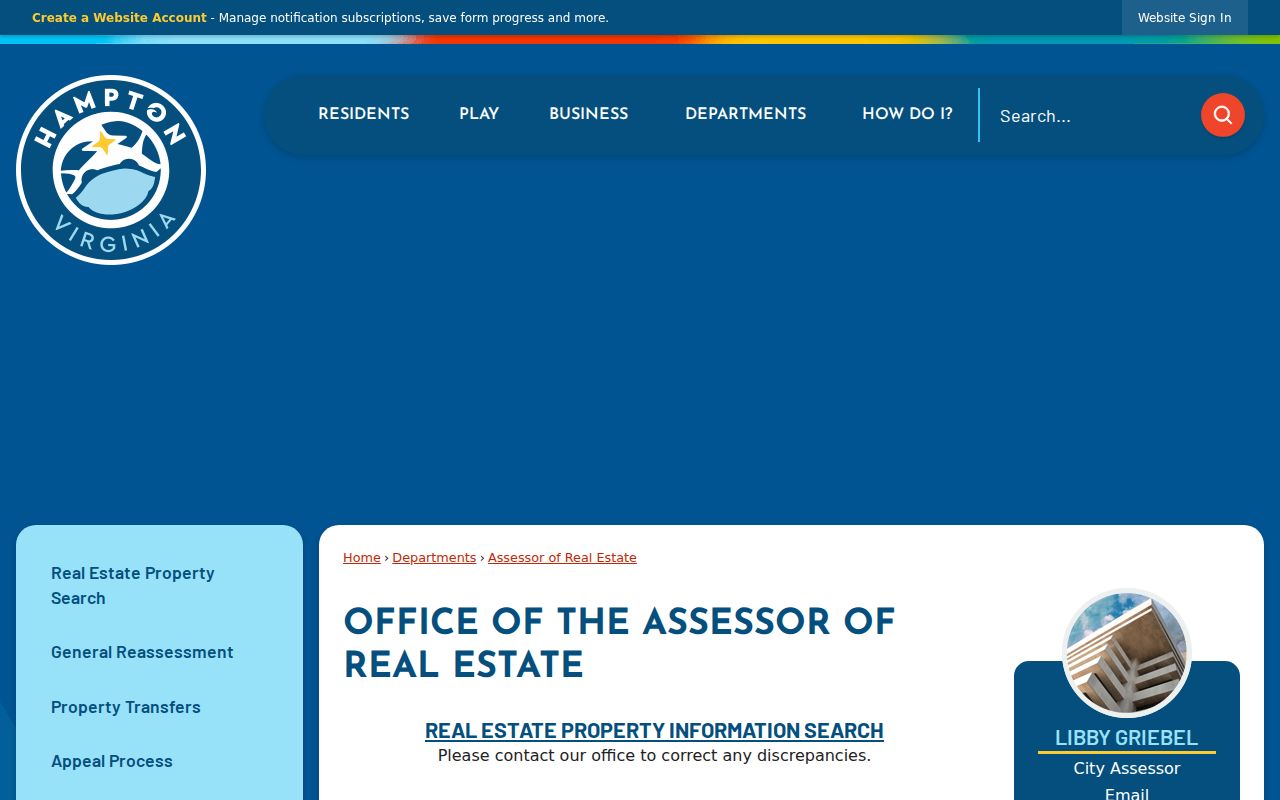
The Assessor screen is the beginning of an address trail. The follow-up record should be a transfer report or a Clerk instrument, not an assumption about every person at the location.
Authorized Hampton Voter Access
Virginia’s Citizen Portal is not a public name directory. Its status form requests first name, last name, date of birth, the last four Social Security digits, and a locality, with a certification that the requester is the voter or is authorized. It can help a voter check an address, polling location, voting history, or related status. It cannot be used as an arbitrary-person search, and it does not provide a street list.
Public registrar lists follow a different path. Virginia law allows office inspection of certain list information, while Va. Code §24.2-405 limits who may receive a full copy, its permitted use, redistribution, and online publication. The Hampton Registrar can explain the current procedure. Protected addresses, Social Security information, and day and month of birth do not belong in a residents directory result.
Virginia’s authorized voter-status form shows the certification-based route.
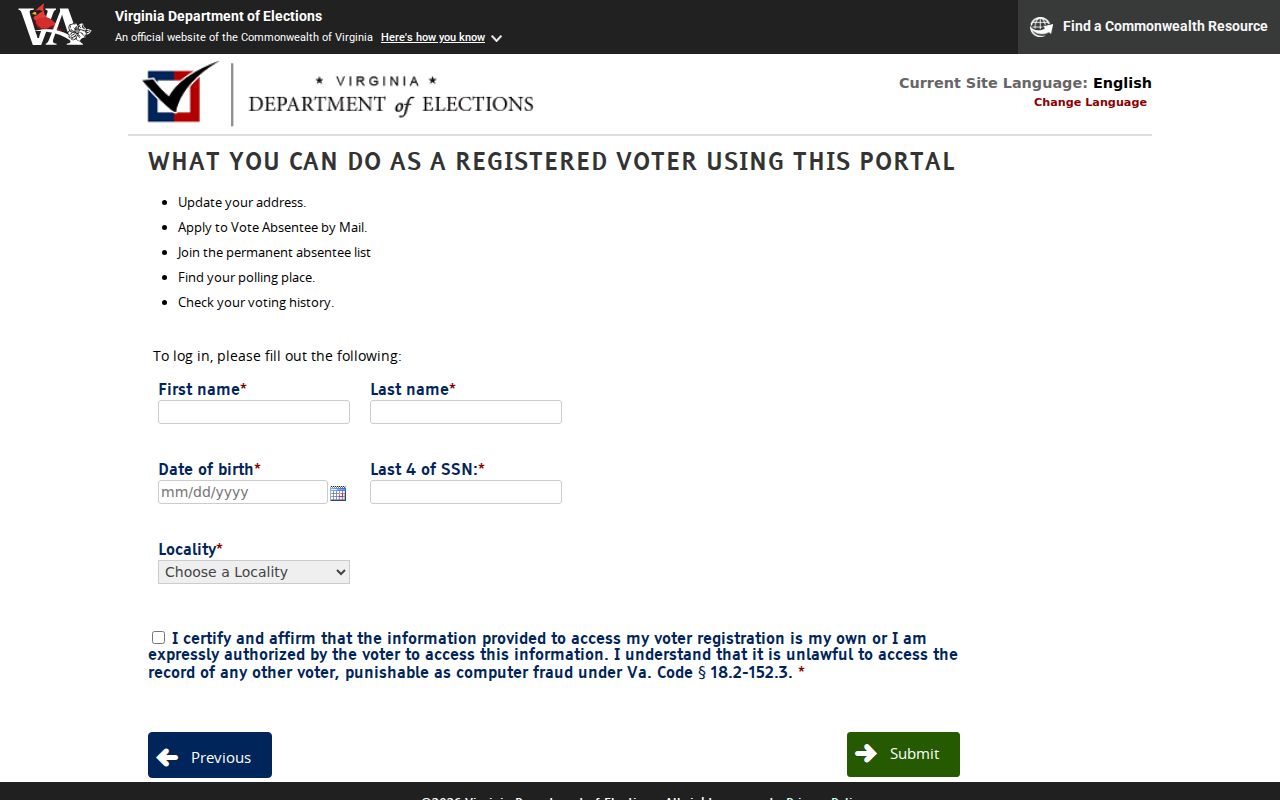
Its required identity fields illustrate why a voter record needs a lawful, person-specific purpose rather than a broad directory search.
Current Hampton Directory Sources
Current sources are best read as separate rolls. They document a relationship to a parcel, filing, public role, or election process rather than a complete household. The Hampton residents directory approach is to select the source that answers the narrow question, record its date, and compare it with another source when identity matters.
| Hampton source | Relationship shown | Custodian | Access route |
|---|---|---|---|
| CivQuest and Land Book | Parcel owner, taxpayer, assessment | Hampton Assessor | Current portal and annual PDFs |
| Property transfer PDFs | Grantor, grantee, property ID, date, amount | City of Hampton | Calendar years posted 2020-2026 |
| Recorded instrument index | Grantor, grantee, trustee, estate, or other party | Hampton Circuit Court Clerk | Clerk counter and SRA/COVERS rules |
| Authorized voter route | Voter’s own status and election context | Registrar and Virginia Elections | Certification or statutory list process |
| DPOR and SCC records | Public license or entity role | Virginia agencies | Official online lookup |
A court party, business officer, or license holder may have a role in Hampton without residing at the address shown. The Hampton resident lookup explains how to compare those roles without merging them into one profile.
Hampton Address Resource Crosswalk
City Services for My Address adds civic context after an address is selected. The city workflow accepts a street number and an autocomplete street name after terms are accepted. Its resource tab can identify zoning, wetlands, service schedules, a Neighborhood Commission district, voting information, legislative districts, and a crime-statistics area. Those layers are useful for understanding which Hampton office or district covers a property. They are not evidence that a named person currently lives there.
Hampton’s GIS is also a useful geography check. A ZIP polygon, voting precinct, parcel, and neighborhood district can overlap without having the same boundary. For a postal address, confirm delivery with USPS; for an ownership question, return to the parcel and the recorded instrument. That distinction matters in waterfront, institutional, and historic-place areas of Hampton.
Note: Save the street number, matched street name, parcel ID, and date used in an address search before comparing records from different city systems.
Verify Hampton Names Independently
One name is rarely enough. Begin with the full name, initials or spelling variants, a date range, and the location label used at the time. For events before the 1952 consolidation, search Hampton alongside Elizabeth City County, Phoebus, Old Point, Kecoughtan, Kecoughton, and East Hampton. A printed directory can use a historic place name even when the modern parcel lies inside Hampton.
Next, add a source with a different purpose. A deed party can be compared with a directory address; an obituary with an open vital index; a court party with a public professional record. Read the whole result. A court result may show a party name, case number, case type, filing date, final-order date, and action. It does not prove that a similarly named person is the same person without time, address, or other lawful corroboration.
- Roll
- A list maintained for one administrative purpose, not a universal resident list.
- Index
- A finding tool that identifies a record; it may not include the document image.
- Criss-cross directory
- An address-to-name section when a printed volume includes one; it must be verified volume by volume.
- Legal description
- The parcel wording used in a deed or land record, often more durable than a street address.
Hampton Courts and Vital Paths
Virginia Courts case information can lead to public Hampton circuit and General District Court records. Search options can include locality, party name, case number, and hearing date. The Clerk counter and public terminals are the fallback when an online result is incomplete. Juvenile, sealed, and other protected matters are not made public through a general search. Circuit land-record images can have separate SRA/COVERS subscriber and local-clerk rules, so an online index is not the official record itself.
Virginia Department of Health is the custodian for vital certificates. Birth records become public after 100 years, and death, marriage, and divorce records after 25 years. For newer records, eligibility and identification rules apply. The current VDH application page reported a $15 search or copy fee, while an older form displayed a different amount, so verify the live fee and timing before sending payment. Hampton’s Clerk and the Library of Virginia can be useful local and historical companions, but they do not replace VDH’s certificate rules.
Hampton has no official public online jail roster identified in the research. For a current local custody question, the Sheriff or Inmate Records unit is the direct route; state and federal locators have their own scope and disclaimers.
Virginia Department of Corrections locator guidance illustrates a state route with a specific custody scope.
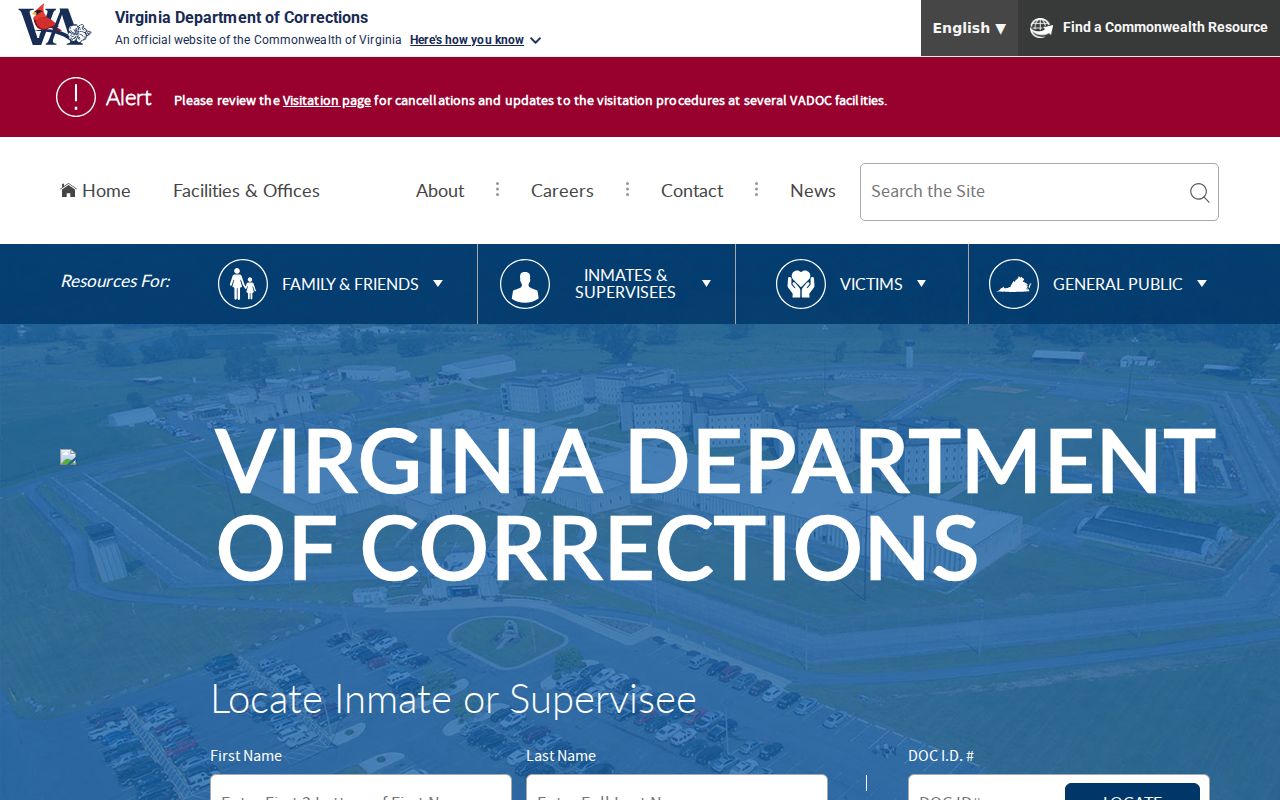
A locator result identifies a public custody status at a point in time. It is not a complete criminal history or a substitute for the court record.
Historical Hampton Resident Directories
Hampton’s historical directory shelf is especially valuable because it preserves the place labels that changed after consolidation. The Hill Directory Company run serving Newport News, Hampton, Phoebus, and Old Point begins with 1897-1898 and continues in detailed volumes through 1929, with a later 1944-45 catalog title. It can give a printed name, address, occupation or status descriptor, and business listing. Each entry is an annual snapshot, not proof of a present household.
Hampton Public Library Special Collections holds Hampton and Newport News directories with newspapers, yearbooks, census indexes, maps, local wills, deeds, vital references, and the Daily Press Obituary Index. FamilySearch catalog films, Library of Virginia microfilm, the History Museum, and Hampton University Archives extend the search when the local shelf or an image is not available online. The dedicated Hampton city directories collection page keeps the film and access details together.
Elizabeth City County Search Labels
Hampton is an independent city today, but Elizabeth City County was the historical jurisdiction until its 1952 incorporation into Hampton, along with Phoebus. This is more than a name change. Deeds, wills, chancery causes, marriage material, newspapers, and directory titles may be indexed under Elizabeth City County or a historic community name. A negative Hampton-only search is often a reason to change the locality term before concluding that the record is absent.
Historic records also have real gaps. The Library of Virginia documents losses tied to wars and the 1865 Richmond evacuation fire. When a deed trail breaks, check re-recorded deeds, chancery causes, surveys and plats, probate, land books, newspapers, and church or cemetery leads. The Elizabeth City County chancery collection has digital images for 1747-1913, making it a useful sideways route for family and property facts that missing deed books cannot supply.
Hampton Library Archive Leads
Special Collections is at the rear of the second floor of Hampton’s Main Library, 4207 Victoria Boulevard. Its genealogy computers are best used by appointment. The room’s hours differ from general library hours, and the library asks researchers to call before a visit. A mail-only preliminary research request remains available for a specific name, date, or event when a visitor cannot use the collections in person. It requires a letter and a self-addressed stamped envelope, not an email or phone request.
The Hampton History Museum catalog adds oral histories, photographs, maps, and location browsing. Hampton University Archives supports searches by record group, location, date, title, description, subjects, and keywords; its search guidance directs individual names to Subjects. These collections make a strong historical companion to a residents directory because they explain a house, neighborhood, school, or institution around a bare name.
Hampton Library Virginiana and Genealogy describes the local historical holdings and access route.
Hampton FOIA Record Requests
The Virginia Freedom of Information Act, Va. Code §2.2-3700 et seq., is Hampton’s public-records fallback. Under §2.2-3704, a public body generally responds within five working days by providing records, denying them, partially responding, stating that records do not exist, or explaining that more time is needed. Ask for an existing record with reasonable specificity: name the Hampton department, the record type, address or parcel ID, date range, and preferred electronic format.
Hampton accepts requests through GovQA as well as designated mail, fax, email, or phone channels. Actual reasonable costs can apply, and the city may request a deposit for a large estimate. A request cannot force the city to make a new database, identify every person from scattered files, or release protected voter, vital, juvenile, confidential-address, or investigative information. Requesting a redacted copy is often the right choice when only part of a record is exempt.
Hampton’s GovQA request portal is the online submission route.
The city’s request portal is useful when a defined existing record is not published online. It is not a search box for a newly created resident list.