
Hampton City Directory Collections
Hampton's strongest printed directory trail is the J.L. Hill run serving Newport News, Hampton, Phoebus, and Old Point. The titles matter. A name tied to Phoebus or Old Point belongs in a Hampton search today, while Hilton Village belongs in Newport News. Hampton Public Library confirms that it holds Hampton and Newport News city directories, but its public collection page does not give a separate shelf-year list. The FamilySearch catalog supplies the most precise run and film numbers. Treat that catalog as a way to locate a volume, not a promise that every image will open from every device.
| Collection | Years | Where Held | Access |
|---|---|---|---|
| J.L. Hill Hampton-area directories | 1897-1898 to 1920; 1923, 1925, 1927, 1929 | FamilySearch catalog films and Hampton Library | Catalog, film, or local collection access |
| Later Newport News directory title | 1944-1945 catalog title | FamilySearch catalog | Check image rights and sign-in status |
| Hampton Library Virginiana | Exact shelf years not published | Main Library Special Collections | In-person local-history research |
| NARA Newport News listing | 1927, 1929, 1931, 1933, 1935 | National Archives directory listing | Use to cross-check a date |
The documented Hill sequence is near-consecutive through 1920, then has listed later volumes rather than a claimed yearly run. The last printed local year has not been located in official sources. That gap matters when a Hampton household appears before 1929 and then disappears from a researcher's available catalog view.
See the FamilySearch Hill directory catalog before choosing a year or film.
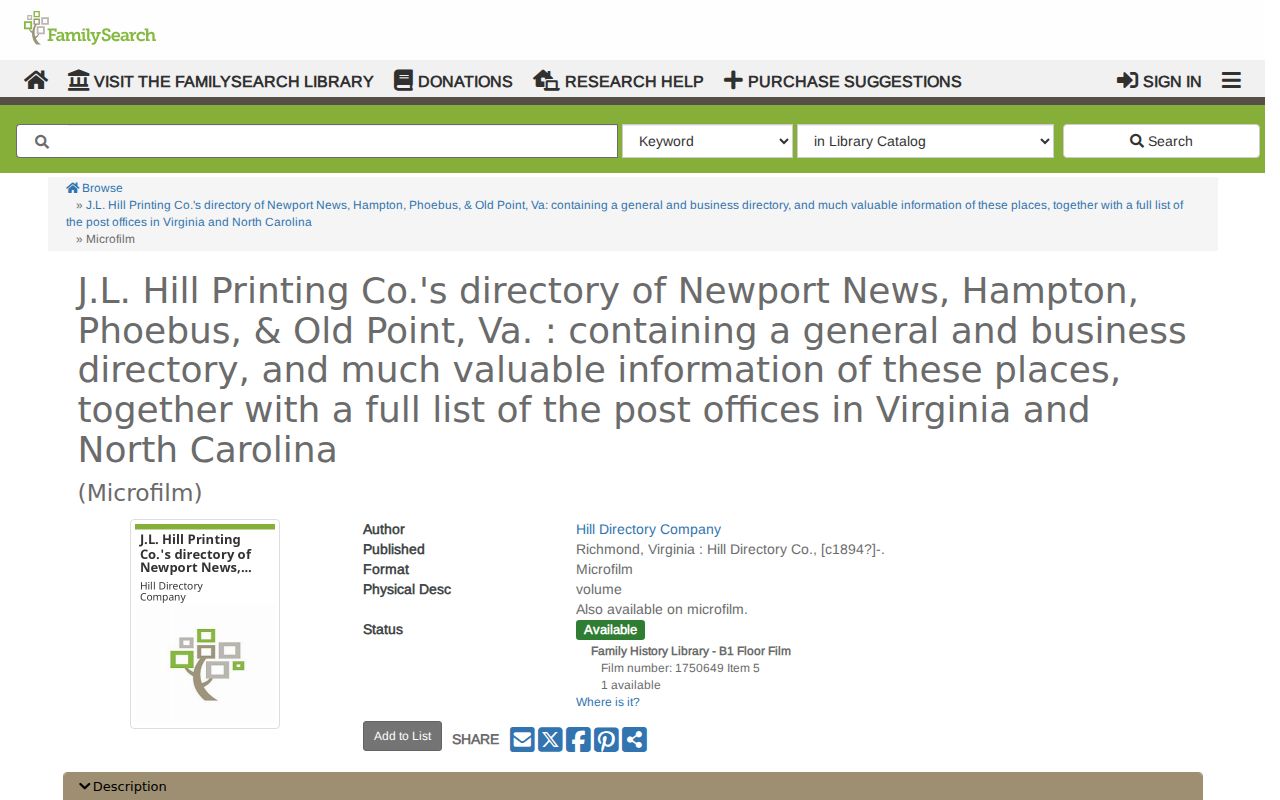
The catalog image is useful for preserving the title, volume, year, film number, and item number with every Hampton citation.
Hill's Hampton City Directory Years
The Hill catalog divides the Hampton material across six film groupings. This is a practical chronology when a Hampton surname is being checked year by year. Film 1750649 contains volume 3 for 1897-1898. Film 1750650 continues from 1898-1899 through the 1904 volume. Films 1752736, 1752737, and 1752738 carry the 1905 through 1920 sequence. Film 1752739 contains the listed 1923, 1925, 1927, and 1929 volumes. Record the film and item as well as the printed date.
- 1897-1898: Hill volume 3, film 1750649, item 5.
- 1898-1899 through 1904: volumes through volume 9 on film 1750650.
- 1905 through 1916: volumes 10 through 20 across films 1752736 and 1752737.
- 1917 through 1920: volumes 21 through 24 on film 1752738.
- 1923 through 1929: listed later volumes 25 through 28 on film 1752739.
The 1944-1945 catalog title is evidence that a later directory title included the Hampton area. It does not establish uninterrupted publication, a complete local shelf, or a final publication date. FamilySearch access also varies. Some catalog links can require a sign-in or be limited by rights at a particular location, so note the restriction instead of treating a closed image as a missing record.
Read Hampton City Directory Entries
A Hampton directory entry should be transcribed as printed before it is normalized for a modern search. Start in the surname section. Check initials and spelling variants, including a relationship or status abbreviation only when it is visible. The research record supports capturing a printed name, street address, occupation or status descriptor, and business entry where present. The exact page layout must be inspected in the selected scan. Do not add a spouse, an ownership mark, or an occupancy claim that the chosen entry does not show.
| Printed name | Copy initials, surname, and spelling exactly as they appear in the Hampton volume. |
|---|---|
| Street or place | Keep the address and the printed locality label together, including Phoebus, Old Point, or Kecoughtan. |
| Descriptor | Record an occupation, status phrase, or business description only if the entry visibly supplies it. |
| Source marker | Preserve directory title, year, page, volume, film, and item when available. |
| Research note | Use a separate note for a modern place name or a possible match, never as a silent replacement for the printed wording. |
The entry itself is a snapshot. It can identify a listed householder, business contact, boarder, institution, or prior resident, but it is not a present-day roll. A Hampton name that vanishes may reflect a move, death, changed spelling, omission, or a missing available volume.
- Criss-cross section
- A street-order portion sometimes found in a directory. Check the selected Hampton volume for one; a separate local reverse-directory run has not been located in official sources.
- Householder route
- The surname portion used to find a printed household listing before checking any available street-order section.
- Abbreviation key
- The volume's own explanation of shortened terms. Consult it before expanding a notation such as “wid.” in a Hampton transcription.
Hampton Directory Shelf Access
Hampton Public Library's Special Collections is at the rear of the Main Library's second floor, 4207 Victoria Boulevard. Its hours are Monday and Thursday, 1:00 to 7:00; Tuesday and Wednesday, 9:00 to 5:00; Friday, 9:00 to 1:00; and Saturday and Sunday, 1:00 to 5:00. Those hours differ from the general library hours. Appointments are recommended for genealogy computers, and Special Collections can be reached at 757-727-1314. Bring a precise Hampton name, date range, place label, and address question.
Special Collections brings related evidence together: Hampton and Newport News directories, census indexes, yearbooks, newspapers, Sanborn maps, local wills, deeds, vital references, vintage photographs, and in-house Ancestry Library Edition. The library's Daily Press Obituary Index is a useful name-and-date lead, although the exact index coverage was not located in official sources. The in-house database access is not remote access.
Open the Hampton Virginiana and Genealogy collection description before planning a visit.
The collection listing shows why a Hampton directory date is best checked beside maps, newspapers, and other local materials.
For someone who cannot visit, Hampton offers an unusually specific fallback. Mail a request naming the person, date, and event, include a self-addressed stamped envelope, and address it to Hampton Public Library, ATTN Special Collections, 4207 Victoria Blvd, Hampton VA 23669. The library performs preliminary checks of its own resources only. It does not accept that research-request route by email, web form, or phone. No set fee is listed; donations are welcome.
Hampton Directory Place Labels
Hampton searches need a small geographic crosswalk. Before the 1952 consolidation, the same general area can appear under Elizabeth City County, Phoebus, Old Point, or Kecoughtan. Hill titles make that change visible: the 1902 title names Newport News, Hampton, Phoebus, and Old Point; a 1918 catalog title includes “Kecoughton [sic]”; later notes include East Hampton. Retain the catalog spelling, including the bracketed sic, and add a current Hampton place in parentheses in a research note.
Elizabeth City County was created in 1634 and became part of the independent City of Hampton after July 1, 1952, with Phoebus also incorporated. This is an indexing issue, not just local history. A negative Hampton directory search can be incomplete if the catalog or newspaper uses the older county or settlement label. Hilton Village is the counterexample: it is now in Newport News, so it should not be silently folded into Hampton.
Trace Hampton Directory Households
Build a dated Hampton household trail rather than a single-name answer. The safest method pairs a listed person with the exact directory year, printed street, descriptor, and source page. Then compare the next available volume, not an assumed annual sequence. A street number can change, a person can move, and a name can be indexed differently. When the goal moves to a current address, the Hampton by-street directory uses the modern parcel and address route instead of rebuilding the historical shelf.
- Find the earliest likely Hampton entry by surname, initials, and historic place label.
- Copy the entry and its citation before looking for a later year.
- Follow only the next available Hill volume, recording each changed street, descriptor, or spelling.
- Check a criss-cross or reverse section if the chosen volume actually contains one.
- Pair the directory date with a census, newspaper notice, deed, obituary, or vital source that can test the connection.
A compact Hampton timeline has useful gaps on purpose: 1897-1898 is the first clearly located Hill volume; the run is near-consecutive through 1920; 1923, 1925, 1927, and 1929 are later listed volumes; and a 1944-1945 catalog title supplies a later clue. The last local printed year is not located. Marking that limit prevents a false conclusion from a blank catalog year.
Hampton Archive Directory Context
Hampton University Archives can add an institutional or community record after a directory name has been located. Its finding aid searches Record Group, Location, Date from and to, Title, Description, Subjects, and Keywords. The archive advises placing individual names in Subjects rather than Keywords. A result may show a thumbnail and summary, with Read More for the fuller record. This makes it a useful Hampton follow-up for university, organization, event, or photograph context, not a substitute for a directory entry.
Use the Hampton University Archives search with the printed place and date from the directory.
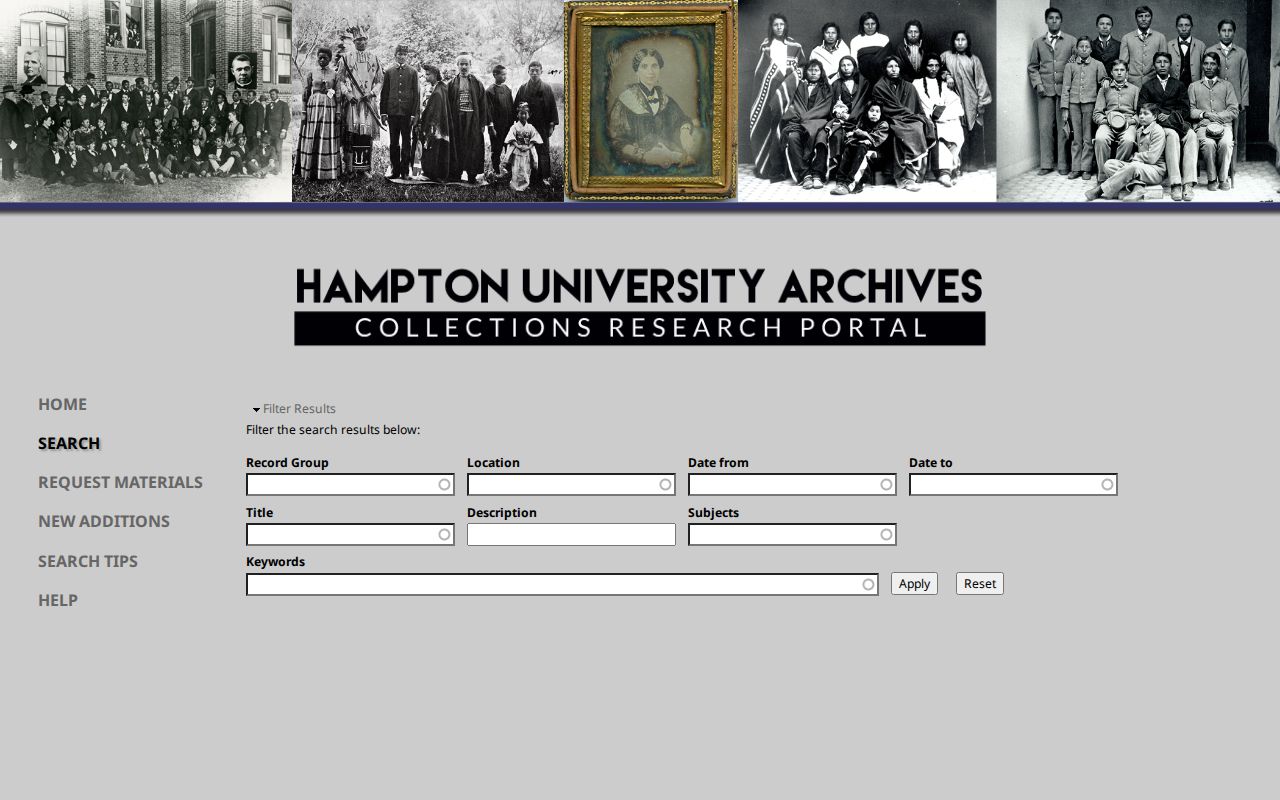
The archive fields support a targeted Hampton search when a directory listing points to a community, institution, or event.
The Hampton History Museum offers another contextual collection. Its catalog includes object records, photographs, oral histories, maps, Cheyne Studio material from 1894 into the 1960s, and Girard Chambers Jr. maps and surveys from the nineteenth and early twentieth centuries. Search by location, keyword, or last name. Catalog records can be incomplete and can preserve harmful historical terminology, so capture the catalog identifier and use the inquiry route for image or reproduction questions.
Browse the Hampton History Museum collections for the name or street in a dated listing.
Museum images and maps can place a Hampton directory address in a street scene without claiming that the pictured person is the listed resident.
Hampton Directory Map Context
Sanborn maps bridge a Hampton street listing to the built setting. The Library of Congress holds Hampton sets for 1885, 1891, and January 1916; the 1916 set has 42 sheets. It can show a structure's footprint, use, street names, nearby buildings, and neighborhood context. Hampton Library guides also identify local Sanborn microfilm through later decades. A map does not name an occupant. Pair it with the selected directory entry, census, deed, or newspaper before connecting a person to the property.
For deeper county-era context, the Library of Virginia holds Elizabeth City County deeds, wills, marriage, order books, guardians, surveys, plats, and chancery material. Some records were lost in wars and fires. Chancery images from 1747 to 1913 can recover family or property facts when a deed trail breaks. Preserve a Hampton or Elizabeth City County reel, volume, and page, not just a broad repository name.
Hampton City Directory Limits
A Hampton historical directory is a research source, not a complete person list. It may omit a person, use initials, reflect an old address, or describe a business connection rather than a household. Directory and map work is strongest when it preserves uncertainty. Use the catalog title, year, image availability note, printed locality, and page as the base citation. Add independent evidence only where it matches the same date and place.